
Whenever I pull my service truck into a driveway, the most common question I get from skeptical homeowners is whether this whole process is a scam. They point to the removable screen inside their appliance and ask, “I empty that every time, so is dryer vent cleaning necessary?” After spending over two decades crawling through fiberglass-filled attics, navigating muddy crawl spaces, and pulling literal buckets of compacted, highly flammable lint out of residential exhaust lines, my answer is an unequivocal yes. As a veteran in the insulation and ventilation industry, I have seen the devastating consequences of ignored ductwork. A laundry exhaust system is not a set-it-and-forget-it appliance component; it is a critical thermal exhaust highway that demands strict maintenance. In this deep dive, I am going to share my field-tested knowledge, specific diagnostic metrics, and the exact reasons why professional intervention is non-negotiable for the safety and efficiency of your home.
Why exactly do lint traps fail to catch all the debris?
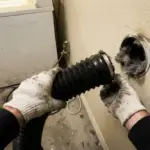
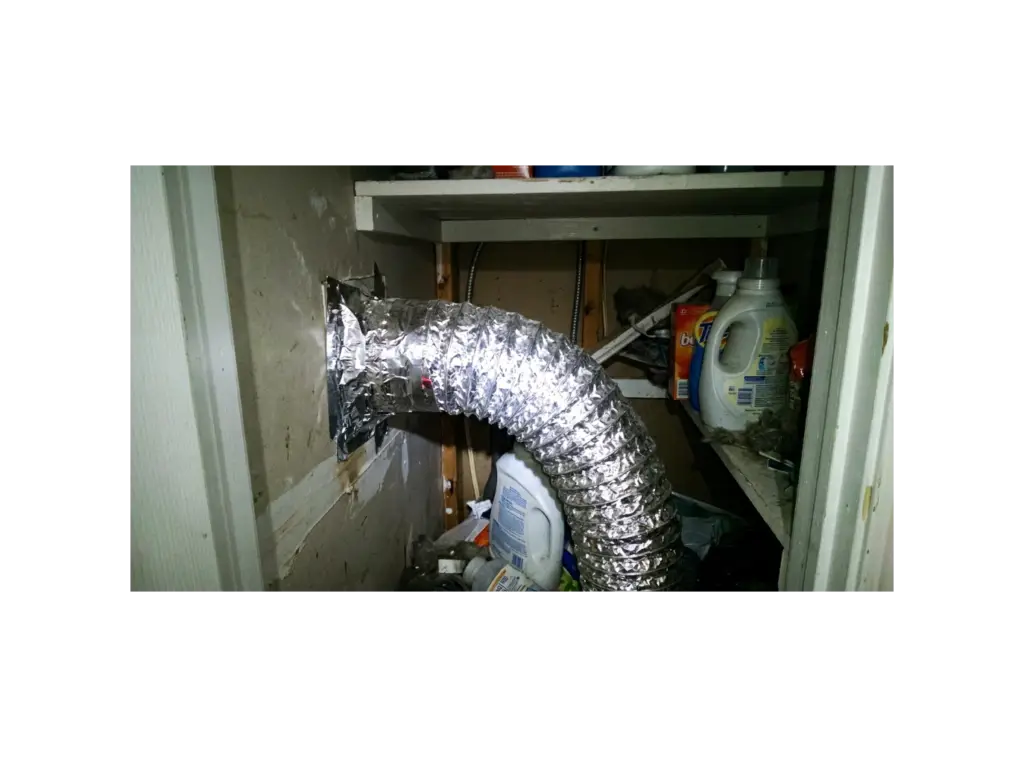
Lint traps fail to catch all the debris because they are intentionally designed to capture only about 70 to 80 percent of macroscopic fibers, allowing microscopic particulate and moisture to bypass the screen to maintain necessary airflow. If the manufacturer made the mesh screen fine enough to catch every single particle of dust, pet hair, and cotton fiber, the dryer would suffocate within the first ten minutes of a cycle. Your appliance needs to push roughly 150 to 200 Cubic Feet per Minute (CFM) of hot, humid air out of the drum to dry your clothes. The microscopic particles that slip past the lint screen travel into the galvanized steel or aluminum transition duct. Because this exhaust air is heavily laden with moisture, this fine dust doesn’t just blow outside; it acts like a sticky paste, adhering to the walls of the ductwork. Over a few years, this paste calcifies into a thick, felt-like tube that slowly chokes the diameter of the pipe. Just last month, I scoped a standard 4-inch rigid duct in a suburban home. The homeowner thought her dryer was broken. When I inserted my Milwaukee inspection camera, we found that the internal diameter had been reduced to just 1.5 inches by a solid ring of pet hair and fabric softener residue. The static pressure had skyrocketed, and the machine simply couldn’t breathe.
What are the financial and safety risks if I ignore this maintenance?
If you ignore this maintenance, you risk catastrophic house fires triggered by ignited lint, alongside skyrocketing energy bills caused by prolonged drying cycles and thermal inefficiency. Let’s talk about the physics of a dryer fire. Inside your appliance, there is a heating element that can easily reach temperatures of 135 to 160 degrees Fahrenheit during a normal cycle. When the exhaust line is choked with lint, the hot air cannot escape. The heat backs up into the chassis of the machine. Lint is essentially highly processed kindling—it is what survivalists use to start campfires. When the internal temperature of the dryer chassis exceeds the ignition point of the trapped lint, a spark from the heating element or a failed thermal fuse can cause the entire machine to combust. Beyond the severe fire hazard, there is a massive financial drain. A clogged vent forces your heating element to run twice as long. Instead of a 45-minute cycle, you are running the machine for 90 minutes or more.
Here is an insider’s tip to save money: Invest in a rigid metal transition duct instead of the cheap, flexible foil ones. The ridges in flexible foil hoses create vortexes in the airflow, drastically slowing down the CFM and causing lint to drop out of the air stream and collect in the ridges. A smooth, rigid metal pipe allows the air to travel at maximum velocity, keeping the line cleaner for much longer and saving you money on both electricity and the frequency of professional cleanings.
How do professionals definitively prove that intervention is required?
Professionals definitively prove intervention is required by measuring the static pressure and exhaust velocity using a digital manometer and an anemometer at the exterior wall termination. I never guess; I rely on hard data. When I arrive at a property, the first thing I do is attach a Magnehelic gauge to the exhaust line behind the dryer to measure the static pressure in inches of water column (inWC). A clean line should register below 0.5 inWC. If I see a reading of 1.2 inWC or higher, I know there is a severe restriction. Next, I go outside to the termination hood with my digital vane anemometer. A healthy airflow velocity should read between 1,200 and 1,500 Feet Per Minute (FPM). If it is blowing at 300 FPM, we have a major problem. Once the data confirms the blockage, I deploy my professional dryer vent cleaning service rig. I use a 200 PSI industrial air compressor paired with a reverse-blowing pneumatic skipper ball. This tool blasts high-pressure air backward while aggressively scouring the metal walls, tearing away years of compacted sludge.
Can a blocked laundry exhaust lead to pest infestations?
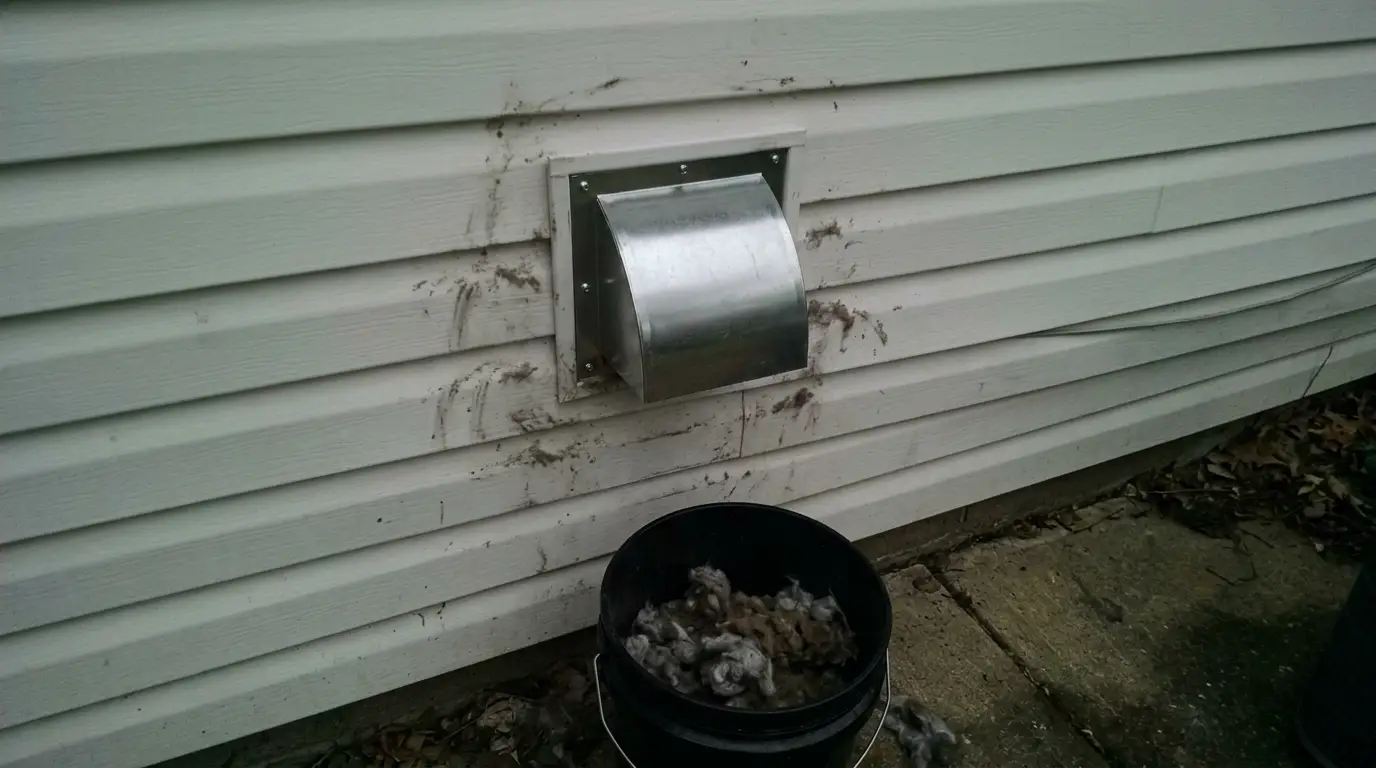
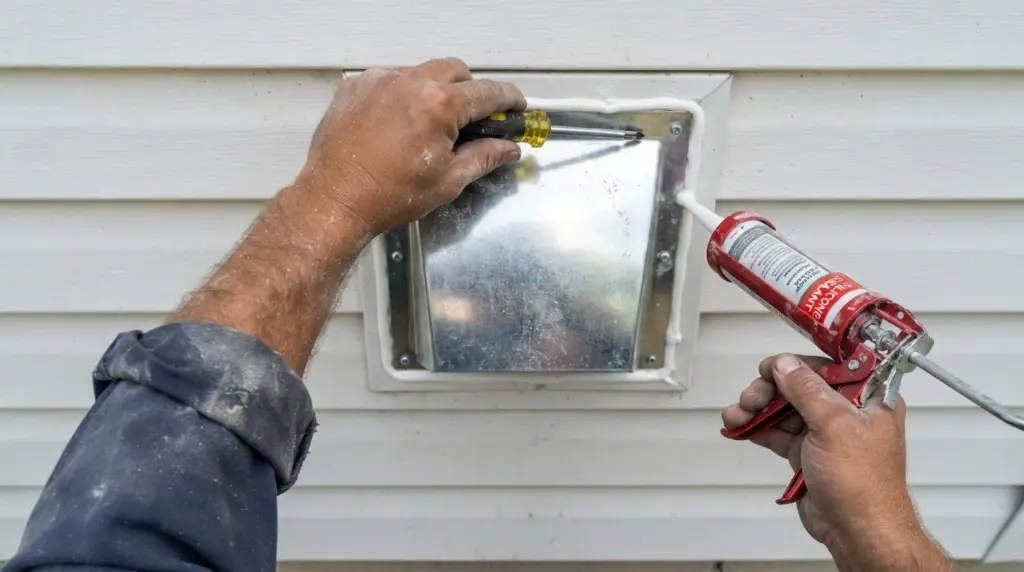
Yes, a blocked laundry exhaust can absolutely lead to pest infestations because the buildup of warm, moist lint prevents the exterior louvered dampers from closing fully, creating an open door for rodents and birds. This is a massive crossover issue in my line of work. The exterior vent hood has flappers that are supposed to snap shut when the dryer turns off. When lint builds up on those hinges, the flappers stay propped open. During the cold winter months, mice and rats feel that radiant heat escaping from the pipe and crawl inside. Lint makes the perfect, insulated nesting material. I cannot tell you how many times I have run my rotary brush down a line only to extract a massive, abandoned rodent nest blocking the entire 4-inch pipe. Once mice get into the vent, they often chew through flexible ducting in crawl spaces or attics to gain access to the rest of the house. This is why addressing ventilation issues is a critical first step in comprehensive rodent proofing. If your ductwork is compromised, you are essentially rolling out the red carpet for unwanted pests, leading to contamination and a sharp drop in your home’s indoor air quality.
In conclusion, when homeowners ask me, “is dryer vent cleaning necessary?”, the physical evidence I pull from their walls answers the question for them. Relying solely on the little lint trap inside your machine gives a false sense of security. The accumulation of fibrous debris, the mathematical drop in exhaust velocity, the strain on your appliance’s mechanical parts, and the very real threat of a thermal event are not myths—they are structural realities. By trusting a seasoned professional to measure, scour, and sanitize your exhaust lines with commercial-grade pneumatic equipment, you are not just improving your laundry times; you are actively investing in the structural safety, energy efficiency, and long-term integrity of your home.